It's been a minute since the last time I published here, and quite a lot has happened in that time.
First I took a small break to think about projects I really wanted to build, made a list of them and settled my ideas. Then I started the last bit of work for the SVPT which is still being worked on (since I decided to explode the size of the original project 10x). and I noticed one thing that I haven't stopped to look at in some time…
The unexpected realization
Since I started working with Webflow; building client projects as part of Skyrocket, maintaining my personal website, working with my own clients and even when working on side projects I really believed the platform had a lot of potential.
Not only was it fairly affordable but it also allowed me to make so much with almost no overhead. It was great, specially compared with most self-hosting options I’ve worked with before at the time, sure it was a bit more expensive but building anything was so quick and almost all overhead and maintenance needs came pretty much out of the box, design a site click a couple of buttons and you’re set.
Before I moved my website to Webflow I actually started paying the $190 bucks (per person, per year) “Freelance” Workspace subscription which allowed me to work on my clients sites without them needing to make additional payments and also allowing me to have 10 .webflow sites published with full CMS capabilities I thought it was a fairly sweet deal.
Webflow wasn’t just a simple website builder platform, I was paying to have multiple web projects at a time without worrying about Infrastructure, CDN, deployments, backups, and any of the common back end concerns. I was more than happy to take that trade.
Until things started changing; In December 2024, Webflow announced their new seat types in this update. To be fair, I skimmed through the announcement and, because I was already on annual billing, I assumed I would not need to worry about it for another year.
As I stated before I was on the Freelancer Workspace subscription, with 2 seats, myself and my wife (was helping me with some design updates for some sites and we were working on her portfolio too) the subscription then was roughly $380 per year, which yes again wasn’t cheap but it was manageable.
During the year, I finished a bunch of work on several sites, and after deploying my wife’s site about half way through the year, the second seat was left pretty much unused. I was originally intending to cancel it but when the cancellation policy stated that there would be no refund for the plan cancellation, instead it will be account credit, I decided to just wait for the end of the subscription and cancel it.
I was expecting my bill to be around $400, you know, about what it was the first time, but no, the reality hit way harder with a $740 for the Freelancer Workspace, which included my seat, plus one additional “Full seat”, this doesn’t even include the fee for the website which for a CMS site was $29/Mo; This, for me, changed the equation in its entirety.
I do need to give credit to Webflow’s customer-support team. They were incredibly helpful, and within an hour we had the additional seat cancelled and the charge adjusted. I deeply appreciated how quickly they handled it.
That being said, seeing that bill forced me to stop and reconsider what I was actually paying for.
Why I chose Webflow in the first place

I feel like, in order to understand why I felt like the cost was justified in the first place, and why I kept it for roughly 2.5 - 3 years, I need to explain what the platform actually gave back to me.
The first time I worked with Webflow I had little to no clue how the platform worked, for me it was about completing a ticket at work, fixing some UI issues on a site. After a couple of months I was making much larger changes, updating full pages, generating and designing CMS collections, building full CMS sites that worked really nicely and kept the clients happy.
Not only that, there were several features coming up that were genuinely exciting! Webflow logic was supposed to become a full, built-in automation pipeline like make or zappier. User Accounts which will enable subscriptions, memberships and user-based gated content, then the shop which was finally going to allow me to get off Shopify. Devlink was another feature I was really excited for, I actually submitted my application to that one but… never heard back.
It wasn’t just the stuff I was already working with it was what the platform was becoming that made it exciting and worth.
- No overhead for infrastructure
- quick dns connection and site deployment
- automatic CDN out of the box
- easy to collaborate within a workspace and with other clients in the platform
- easy handoff for clients so manage their own site
- really exciting upcoming features
- a reasonable price for the offering
So, enough features and really cool stuff to come that justifies the price for it (IMO at least) And I wasn’t the only one, a lot of people was really excited about where the platform was headed. Heck I went in and made several articles about it, I would advocate clients to move their site from whichever platform to Webflow (of course if it applied), I even created Webtricks to help people do even more with the platform, offering it to the no-code community as an xmas present.
But that hype sadly didn’t last too long.
The value started disappearing
First hit was the deprecation of Webflow’s V1 api, don’t take me wrong, the V2 is great, its just that the move from v1 to v2 was really shaky, I’m talking catastrophically shaky (though not as bad as any of these).
I had to migrate several client projects from one API to the other, and the process was rough. Things did not always work as expected, existing integrations behaved differently and the end-of-life date for V1 had to be delayed more than once because many teams were struggling to complete the migration.
Then Webflow Logic, I had so much fun puting together several flows on Logic, from sign up forms all the way to full trivia apps for specific customers, it was pretty bad to see the feature go forcing me to move to other services, Make.com is the one I ended up going to but that of course came at a cost (and loosing the feature didn’t made Webflow cheaper). It also meant I had to explain my clients why they’d have to pay for yet another subscription in order for their site to do what it was originally doing.
For the record, I still use Make for several projects. It is a great service. The frustration came from having to replace the feature with an external dependency after clients had already invested in the original solution.
Then User accounts and Memberships followed, App Gen’s direction changed as Webflow shifted toward its newer AI-based building tools, and the original DevLink workflow I had been interested in also changed due to the same development tools.
Webflow was still releasing really interesting products, but… many of them arrived as separate paid add-ons rather than improvements to the plans customers were already paying for. Like Webflow Analize and Optimize, with Analyze starting at $9/month for “privacy-friendly behavior tracking”, and Optimize at a whooping $299/month for AI-driven A/B testing and personalization.
The tools may be useful for the right businesses, but those prices, and on top of the Workspace and Site plans customers are already paying for (not to mention the cost per-seat). Many other features also remained limited to Enterprise customers.
And, don’t take it wrong, having enterprise features is normal. The issue is the pattern that the company seemed to be taking: useful products get being removed, replacements come as an external services or additional subscriptions, and the total cost of staying in the platform continued to rise.
Higher prices, less confidence
Even after the higher prices and disappearing features, Webflow could still have justified the premium through reliability. Unfortunately, that was also becoming harder to trust.
Webflow announced they were moving their infrastructure to Cloudflare (needless to mention that Cloudflare is a product I also love, and use in multiple projects, I recommend it to clients and friends too)
However, my day-to-day experience with the platform (and seemingly everyone else’s too) did not become more dependable. It came so badly that webflow released their own post-mortem of a 3 day long system instability issue.
Reliability had originally been one of Webflow’s biggest selling points. I could make a change, publish it and trust that the site would continue running without worrying about packages, updates, security, hosting, asset delivery, caching or deployment infrastructure.
Over time, that confidence started to fade.
These failures individually aren't catastrophic, but they certainly build up. The problem is that reliability was one of the things I was specifically paying Webflow to not have to think about. It began to feel like the more time and money I invested in Webflow, the less the platform was being built for customers like me.
A platform moving away from my needs
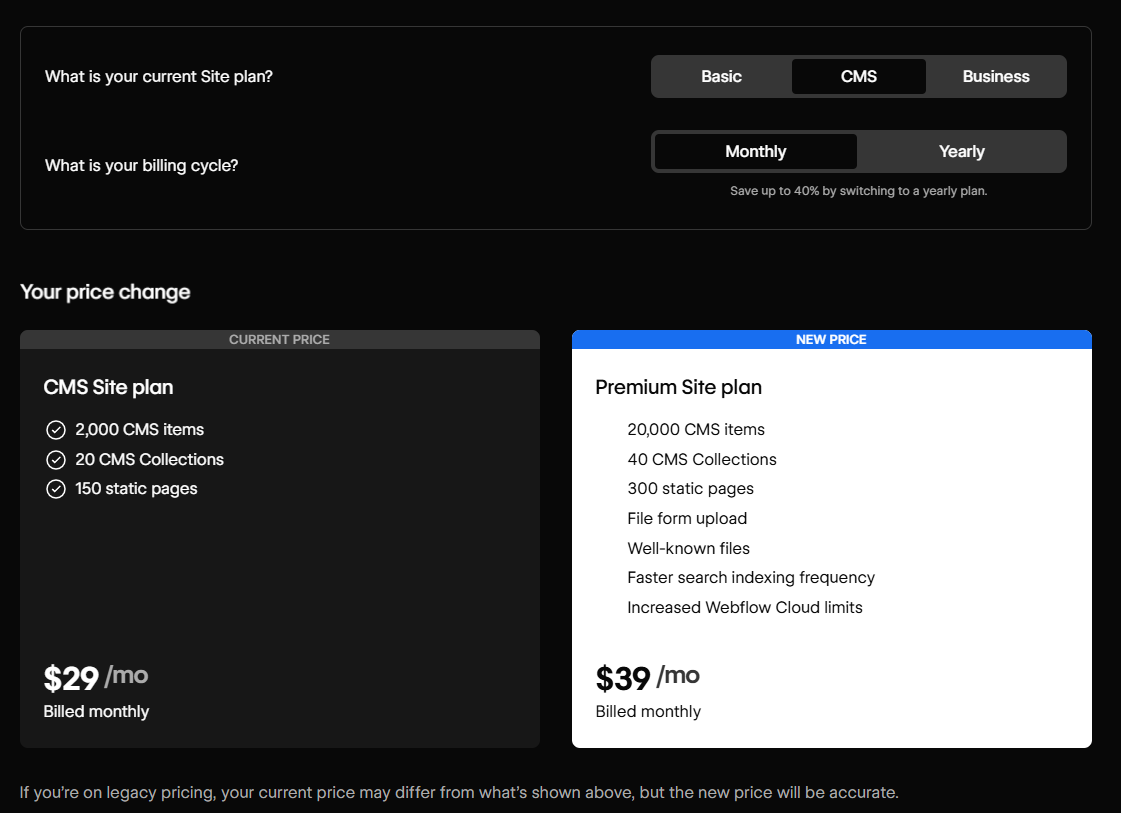
With everything that had been happening, I was already re considering moving off the platflorm, but the last plan change they announced was the final drop. I use the CMS plan because (even in the new pricing) the basic sites won’t include anything CMS wise. but most of my sites and clients have less than 60 pages, less than 500 CMS items, and less than 10 collections, so the first 3 points of “increased features” are meaningless to either of those projects.
Well-known files are incredibly situational, file form upload is not really an improvement is something that should exist by default, and indexing frequency and cloud limits are (in my honest opinion) a solution for a problem they created themselves. So I would be forced to move $10/mo more for really no gain at all, and again, this also applies for multiple other projects.
Now, I hear you, why don’t you use the per year plans from Webflow, it will be way cheaper that way, well… the thing is you need to lock your self to the platform for a full year, it might work for some people, for me it just doesn’t, specially considering webflow’s policies don't usually grant a refund if you cancel half way through. (again their CS team is real good and might be worth appealing, just not really my thing.) this mixed in with the fact that Webflow has an odd tendency of killing features or moving them to a “add-on” pricing, I've already experienced paying into an ecosystem and then having a capability moved elsewhere, and to be honest, No thank you, I’m good.
The question I finally asked myself
I started seeing this pattern and complaining about the changes, I wasn’t alone, a lot of people in the community were unhappy with the direction the platform was taking. When I finally remembered… “I’ve hosted the site myself for over 7 years before, why am I not just doing that?” and so I started building it.
Granted, AI helped make the port of the website quite fast, so I could architect my infrastructure and use my bases to finish in somewhere around a week, and polishing, cleaning up the code, setting up services and infra took a couple more days and boom. that’s all I needed to do.
I can still complain about how my CMS is set but, now my CMS is entirely up to me to decide so if I don’t like something, I just change it, if I want things served in a different way, I just add the feature. You know, that’s the beauty of software development in the end!
I moved to Webflow because it allowed me to make design changes so much faster and the price per month wasn't that much of an increase, I was certainly not expecting how much it was gonna cost me and how little I was actually able to control over time.
Why self-hosting makes sense for me now
Honestly, there are multiple reasons, as I mentioned before, I created Webtricks in order to be able to do more with the platform. This because there’s a lot of limitations that come natively when using a product like this. In my case, my skillset made it so the constrains of the platform are just not worth the cost, both on price and freedom.
Now that i’m self hosting my site, I can have that. and the only limit I’ve got is wether or not I can build what I need.
Full control of the application
I’ve been working with web technologies since I was fairly young, you better believe after over 12 years professionally ding so I know perfectly well how to work around websites and how to make sure they pop.
Being able to specify things as simple as the cache time for assets on the website, add my own automatic compression tools when uploading a photo in the CMS, extending cet CMS without limits to hold the information I want.
Being able to setup a full CI/CD pipeline so just as it was with Webflow, the moment I merge my PR to master it automatically publishes the site. sure, it takes between 2-5 minutes to build, but I have full control over what it does.
A CMS built around my content
.webp)
as you may guess by this article, I do have my fair share of enjoyment sharing content online. and in several occasions I found myself stuck building integrations around webflow’s CMS in order to be able to show the content I wanted to show, but this is not a problem no more.
The main reason why I choose payload for my CMS is because of how flexible it is, I can bring into payload pretty much any type of content and it works flawlessly, the best part, if there’s a type of content I need to add, I can certainly add it to my schema and make sure I extend the dashboard as I need in order to make it fit my needs!
Better control over SEO and performance
I won't say Webflow is bad for your SEO, in fact it is quite good, just not the best.
The main change is that now I can decide how pages are rendered, how metadata and structured data are generated, how redirects and sitemaps work, and how much JavaScript actually reaches the browser. The same applies to performance: caching, image compression, asset delivery and script loading are all decisions I can make myself.
That doesn't automatically make the site faster or better optimized, but if I find a problem, I can actually fix it instead of working around the limitations of the platform.
Infrastructure that supports more than one site
Now another important point is that I changed my infrastructure a lot, so there are some websites I know for a fact I’ll be managing until they are not needed anymore. For all those sites, I’ve got a single mongo cluster with multiple DBs, less than $15 a month for 3 different sites, (of course this plus the $2-$3 for hosting the same sites using AWS), not to mention the couple of cents per month for ensuring my assets are safely stored in my S3 buckets.
What I replaced Webflow with
I’ve already spoken about some things I am replacing Webflow with, but here’s a more clear story along with the pricing for the first couple months (bear in mind the price is total for 2 websites with CMS in self hosting):
Service | Use | Approx. monthly cost |
|---|---|---|
AWS Amplify | Hosting | $5 CAD |
AWS S3 | Assets | $0.70 CAD |
Cloudflare | CDN and DNS | $0 |
MongoDB Atlas | Database | $13.72 CAD |
Payload CMS | CMS | $0 |
HubSpot | Forms and CRM | $0 |
GitHub / Actions | Source control and CI/CD | $0 |
Total | Two websites | ~$19–20 CAD |
These are my current costs, not a guarantee that everyone can run the same setup for $20. Some services are within free usage tiers and costs can increase with traffic and storage, also I deployed the sites a bunch of times to make sure everything looked as I wanted so that ramped up my Amplify bill.
Still, both sites together currently cost me less than a single Webflow CMS site used to cost before even adding the Workspace or extra seats.
What I now have to maintain
Of course, that lower price comes with a trade-off, I now own the infrastructure again.
I have to keep Next.js and Payload updated, watch dependencies and security, maintain deployments, keep an eye on AWS and make sure my data and assets are properly backed up.
If something breaks, it's my problem.
But that's also work I'm already familiar with. Most of it is automated, and in exchange for taking that responsibility back I get full control over the application and infrastructure.
For me, that's a much better trade.
Should everyone leave Webflow?
Absolutely not, I made a point earlier stating that if you are a designer with no knowledge of coding, you probably should stay with Webflow, same goes to agencies I’m not writing this to state it is a bad platform, it really is not, it is just not a fit for me anymore.
Who COULD leave the platform, I’d say anyone with the understanding of what will need to be managed, with knowledge around the infrastructure needs and maintenance, and of course, someone who enjoys this kind of things.
Now, don’t take this post as a call for everyone to leave the platform, Webflow is a good platform, it just isn’t the best pick for all projects, same point goes to Wordpress, Wix, Astro, etc. Every no-code/low-code platform faces several capability limitations because they bring a lot to the table in exchange. This is not to say either of those platforms is bad, they are just good for a specific type of customer.
My recommendation, try things out, don’t get locked into a single provider if you have the capacity to look at multiple and have fun building things!
A new chapter for The Code Raccoons
Honestly, moving back to self hosting was quite the decision, and I'm pretty happy with the results, from my original exported site to the now deployed website I'm able to easily update anything I want and I've got GitHub as my backup manager.
I made my infrastructure change with multiple projects in mind, in this case my own site, my wife's newly deployed website and a couple small projects I'm working on at the moment.
All together costing me less than what I used to pay for a single site. All and all pretty happy that the new site is out and that really excited with the following projects to come, so follow along if you’re interested and happy coding!